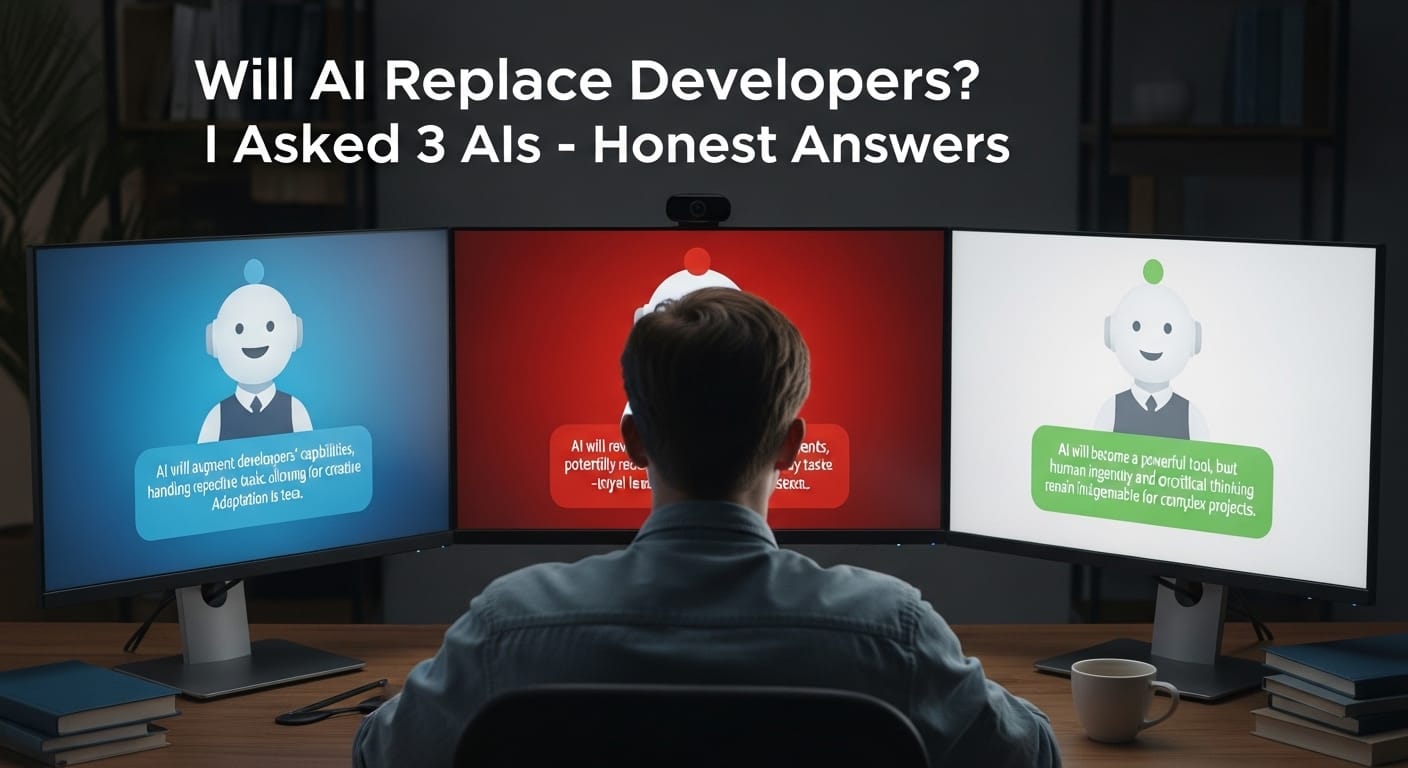
I did something interesting the other day. I asked three different AI models the same brutally honest question: “Will AI replace developers?”
Why? Because everyone’s asking it, but nobody’s giving straight answers. Just vague corporate speak or doom-and-gloom predictions. I wanted the truth—from the AIs themselves.
I asked ChatGPT, Gemini, and Grok. And honestly? Their answers were surprisingly different, brutally honest, and way more nuanced than I expected.
Let me break down what each AI said, translate it into plain English, and share what I actually think is happening right now in 2026.
Table of Contents
What I Asked (The Exact Question)
“Be brutally honest: Will AI replace developers?”
Simple. Direct. No room for corporate fluff.
Now let’s see what each AI had to say.
ChatGPT’s Answer: “AI Won’t Replace You, But Developers Using AI Will”
The Core Message
ChatGPT didn’t sugarcoat it. Here’s the essence:
AI will replace some developers, but not all developers. The key difference? It depends on what kind of developer you are.
Who’s Getting Replaced (According to ChatGPT)
ChatGPT identified three types of developers who are in serious danger:
1. Basic CRUD developers These are folks whose entire job is creating simple forms, basic APIs, and repetitive validation logic. ChatGPT’s brutal truth? AI already does this faster and better.
2. Copy-paste coders You know the type—spend most of the day on StackOverflow, copy code, tweak it, pray it works, repeat. ChatGPT pointed out that AI is essentially a supercharged version of this workflow.
3. Entry-level developers with no fundamentals This one stung. ChatGPT said AI has removed the “easy ramp” into the industry. If you’re fresh out of bootcamp with surface-level knowledge, you’re competing against AI that can write boilerplate code in seconds.
Who’s Safe (And Why)
But ChatGPT wasn’t all doom and gloom. It outlined exactly who’s irreplaceable:
Problem solvers, not code writers AI can write code, but it can’t decide what code should exist. Understanding business requirements, handling edge cases, and knowing what will break in production—that’s still human territory.
System architects AI can suggest patterns, but it can’t make high-stakes architectural decisions. Nobody’s letting AI decide: “Let’s migrate this payment system that handles millions of transactions.”
Debuggers of real-world chaos When production breaks at 2 AM with a race condition that only happens under specific network conditions in legacy code written by five different teams? AI’s useless there.
People who take responsibility Here’s ChatGPT’s killer point: When things break, AI won’t join the emergency call. It won’t talk to angry clients. It won’t take the blame. Companies need humans who own outcomes.
The Warning Shot
ChatGPT ended with this line that I can’t stop thinking about:
“AI won’t take your job. A developer using AI will.”
In other words: The threat isn’t AI. It’s your colleague who’s learned to use AI to become 10× more productive while you’re still doing everything manually.
Gemini’s Answer: “The Junior Developer Role Is Dead”
The Core Message
Gemini was even more direct. Its answer: No, AI won’t replace all developers. But it’s killing the junior developer role right now.
The “Junior Trap” (The Brutal Part)
Gemini dropped some hard truth about entry-level positions:
Companies are hiring fewer juniors because AI can now do what fresh graduates do—write basic functions, create unit tests, generate documentation—faster and cheaper.
The consequence? The career ladder is broken. Getting your first job in tech is significantly harder than it was just three years ago.
If your entire value proposition is “I can write syntax,” you’re already obsolete.
The “70% Problem”
Here’s where Gemini got really interesting. It explained what it calls the 70% problem:
AI is incredible at getting you 70% of the way there. It can spin up a server, write a React component, scaffold a database—all in seconds.
But here’s the catch: The last 30% is exponentially harder. Integration, complex debugging, actual business logic, security considerations—this is where AI falls apart.
And here’s the kicker: AI code is often “subtly wrong.” It looks perfect at first glance but fails under edge cases or introduces security vulnerabilities you won’t notice until production.
Your New Job Description
Gemini painted a clear picture of what developers do now:
You’re no longer a bricklayer. You’re the site foreman.
You spend less time writing code from scratch and more time:
- Reviewing AI-generated code
- Debugging AI hallucinations
- Stitching together the 70% chunks AI creates
- Catching the subtle bugs AI introduces
The “Vibe Coding” Threat
Gemini introduced a term I’d heard but never fully understood: “vibe coding.”
This is when non-technical people use AI to build apps just by describing what they want. A marketing manager building their own dashboard without touching code.
The threat: For simple internal tools or basic CRUD apps, AI genuinely can replace developers.
The defense: Professional software engineering involves scalability, maintainability, and system architecture. AI is terrible at understanding how changing Module A affects legacy code in Module B. That context and institutional knowledge is your competitive advantage.
The Rise of AI Agents
Gemini pointed out we’ve shifted from chatbots (that give code snippets) to agents (that can access your file system, run terminal commands, and fix their own errors).
The workflow is changing dramatically. You’re not typing code anymore—you’re prompting an agent, reviewing its plan, and hitting “approve.”
The risk? If you refuse to use these tools, you’ll be replaced—not by AI, but by a developer who uses AI to do the work of three people.
Gemini’s Verdict
“AI is not a replacement; it’s a filter.”
Replaced: Code monkeys, copy-pasters, juniors who refuse to learn architecture.
Safe: Problem solvers, system architects, product-minded engineers, people who can audit AI outputs.
Grok’s Answer: “Let’s Think This Through Together”
The Core Message
Grok took a completely different approach. Instead of giving me answers, it asked me questions. Hard ones.
It wanted me to define exactly what “replace” means before discussing whether it will happen.
The Questions That Made Me Think
Grok challenged me with:
What do you mean by “replace”?
- No one writing code by hand in 2-3 years?
- Junior roles disappearing?
- Total software engineering employment dropping?
- Or just the kind of person who succeeds changing completely?
This is brilliant because everyone’s talking past each other in this debate. Some people mean “total automation,” others mean “changing skill requirements.”
What patterns have you actually noticed?
Grok pushed me to look at real evidence from the last 12-18 months:
- Are teams shipping faster with AI tools?
- Are companies hiring fewer “code monkeys” and more system thinkers?
- Have you seen AI projects create massive technical debt?
The Mixed Signals
Grok pointed out something crucial: The evidence is mixed.
Yes, AI helps teams ship faster. Yes, some routine coding jobs are disappearing.
But at the same time, companies that tried to run projects with “AI does 90%” often ended up with:
- Massive technical debt
- Hallucinations in critical paths
- Unmaintainable “slop code” that had to be rewritten by humans
The Key Question
Then Grok asked the question that really matters:
“If AI becomes extremely good at writing code from clear instructions… who supplies those clear instructions, splits huge ambiguous problems, makes trade-off decisions, takes responsibility when things catch fire at 3 AM, and keeps evolving the system as business reality changes?”
Does that person sound like today’s mid/senior/principal engineer? Or something new?
The Headcount Paradox
Grok raised a fascinating point I hadn’t considered:
If one developer can now oversee 5-20× more output using AI… what happens to total headcount?
Does it go down? Stay stable? Or actually go up because software becomes so much cheaper and faster to build that more software gets built?
We don’t know yet. But it’s not as simple as “AI = fewer jobs.”
Grok’s Three Scenarios
Finally, Grok asked me to bet on one of three futures:
Scenario 1: AI agents do almost everything; only a tiny elite remains.
Scenario 2: AI eats routine coding → the bar rises sharply → developers who adapt become 3-10× more productive → fewer juniors, more high-skill roles.
Scenario 3: Not much fundamental change; AI stays fancy autocomplete.
Grok didn’t tell me which is right. It asked me to decide based on evidence—and figure out what would change my mind.
Comparing All Three Responses: What Do They Actually Agree On?
Despite different approaches, all three AIs agreed on several key points:
1. Entry-Level Jobs Are Hit Hardest
All three AIs said the same thing: Junior developers and entry-level positions are in serious danger.
- ChatGPT: “The easy ramp into the industry is gone”
- Gemini: “The junior trap—companies hiring fewer juniors”
- Grok: “Fewer ‘code monkeys,’ more high-skill roles”
If you’re trying to break into tech right now with just basic coding skills, you’re competing against AI that costs nothing and works 24/7.
2. The Nature of Development Work Is Changing
All three agreed that what developers do is fundamentally shifting:
- Less time writing code from scratch
- More time reviewing, debugging, architecting
- More time understanding business problems
- More time owning outcomes and responsibility
You’re moving from “code writer” to “code supervisor” to “technical decision maker.”
3. Fundamentals Matter More Than Ever
All three emphasized that deep understanding is your competitive advantage:
- System design and architecture
- Understanding trade-offs and constraints
- Debugging complex, real-world problems
- Translating messy business requirements into technical solutions
AI can generate code. It can’t generate wisdom.
4. The Real Threat Isn’t AI—It’s Other Developers
This might be the most important agreement:
You’re not competing against AI. You’re competing against developers who’ve learned to use AI effectively.
The person who can leverage AI to become 10× more productive? That’s who’s taking jobs—not the AI itself.
5. Refusal to Adapt Is Career Suicide
All three made it clear: Burying your head in the sand is the worst strategy.
If you refuse to use AI tools out of pride or fear, you’ll be left behind—not by machines, but by peers who embraced the change.
Where They Disagreed: The Interesting Differences
Despite the agreements, each AI had unique perspectives:
On Timeline and Urgency
ChatGPT and Gemini: The change is happening right now. Entry-level jobs are already disappearing.
Grok: Let’s look at evidence from the last 18 months and think carefully about what we’re actually seeing.
On Solutions
ChatGPT: Master fundamentals, use AI daily, build end-to-end, understand business.
Gemini: Become the foreman, not the bricklayer. Learn to audit AI outputs.
Grok: Define what “replace” means to you, then decide your path based on evidence.
On Tone
ChatGPT: Direct, practical, action-oriented. “Here’s what’s happening, here’s what to do.”
Gemini: Analytical, almost clinical. “Here are the brutal statistics and structural changes.”
Grok: Socratic, questioning. “Let’s think through this together and examine our assumptions.”
What I Think Is Actually Happening (My Take)
After analyzing all three responses and watching the industry for the past year, here’s my honest opinion:
The Truth: It’s Not Replacement, It’s Evolution
AI isn’t replacing developers. It’s forcing rapid evolution of what “developer” means.
Think about it like this: When calculators were invented, we didn’t eliminate mathematicians. We eliminated human calculators. Mathematicians evolved to solve more complex problems.
Same thing here.
The Junior Crisis Is Real
This is the hardest truth: Breaking into tech as a junior developer in 2026 is genuinely difficult.
The traditional path—learn to code → get junior role → learn on the job → advance—is broken.
Why? Because AI has commoditized the exact skills that junior roles used to teach:
- Writing basic functions
- Following established patterns
- Fixing simple bugs
- Creating boilerplate code
Companies can’t justify hiring someone for $60K-80K to do work that AI does for $20/month.
But Here’s the Opportunity
The bar has risen, but the ceiling has also risen.
If you can:
- Understand complex systems
- Translate business needs to technical solutions
- Debug production nightmares
- Make architectural decisions
- Own outcomes when things break
- Use AI to amplify your productivity
…you’re not just safe. You’re more valuable than ever.
One developer who can do all this with AI assistance can produce what used to take a team. That person commands serious compensation.
The “70% Problem” Is the Key
Gemini nailed this: AI gets you 70% there, but the last 30% is exponentially harder.
I’ve seen this in action. AI can scaffold an entire application in minutes. Impressive!
But then you hit:
- Business logic that doesn’t fit standard patterns
- Integration with legacy systems
- Security considerations
- Performance optimization
- Edge cases nobody thought of
This is where humans shine. And will for a long time.
The Skill Stack That Wins
Based on all three responses, here’s what I think matters now:
Technical depth:
- System design and architecture
- Understanding how things actually work (not just how to use them)
- Debugging and troubleshooting
- Performance and scalability
Product thinking:
- Understanding business context
- Translating requirements to solutions
- Making trade-off decisions
- Knowing what to build (not just how)
AI literacy:
- Using AI tools effectively
- Reviewing AI-generated code critically
- Knowing when to use AI and when not to
- Understanding AI limitations
Communication and ownership:
- Explaining technical decisions
- Taking responsibility for outcomes
- Working with non-technical stakeholders
- Leading projects end-to-end
The Question Nobody Asks
Here’s what I think about most: What if AI makes software so cheap and fast to build that demand explodes?
If one developer can now do the work of five, do companies hire fewer developers? Or do they build 10× more software because it’s now feasible?
We don’t know yet. History suggests new tools increase total demand (we don’t have fewer accountants because of Excel). But the transition is painful.
The Real Filter
All three AIs pointed to this, and I agree completely:
AI is a filter, not a replacement.
It’s filtering out:
- People who can only write code they’re shown
- Developers who refuse to learn beyond their current stack
- Those who won’t adapt to new tools and workflows
- Anyone whose value is purely in typing speed
It’s amplifying:
- Problem solvers
- System thinkers
- Product-minded engineers
- People who own outcomes
- Those who embrace AI as a tool
What Should You Actually Do? Practical Advice
Based on everything all three AIs said, and my own observations, here’s actionable guidance:
If You’re a Junior Developer or Trying to Break In
Don’t sugarcoat it—this is hard right now. But here’s your path:
1. Go deeper than AI can Don’t just learn frameworks. Understand the fundamentals:
- How databases actually work
- How networks operate
- How operating systems manage resources
- How algorithms and data structures solve real problems
2. Build impressive projects Not tutorials. Not following guides. Build something that solves a real problem end-to-end. Use AI to help, but own every line of code.
3. Focus on the 30% Get good at the things AI struggles with:
- Complex debugging
- System integration
- Performance optimization
- Security considerations
4. Develop product sense Understand why software exists, not just how it works. Talk to users. Understand business models. Learn to identify what’s worth building.
5. Use AI aggressively Become the person who’s 3× more productive than peers by leveraging AI effectively. Document how you use it. Make it part of your brand.
If You’re a Mid-Level Developer
You’re in the sweet spot, but you need to level up:
1. Become the AI supervisor Master reviewing AI-generated code. Get fast at spotting subtle bugs, security issues, and architectural problems.
2. Develop architectural thinking Move beyond “how to implement” to “what should we build and how should it scale.”
3. Own entire features or products Don’t just code. Own outcomes. Take responsibility from idea to production to maintenance.
4. Learn to communicate Your value is increasingly in translation—between business stakeholders and technical solutions, between different teams, between current state and desired state.
5. Experiment with AI tools constantly GitHub Copilot, Cursor, Claude, ChatGPT Code Interpreter—use all of them. Find what makes you fastest.
If You’re a Senior/Lead Developer
Your role is evolving, not disappearing:
1. Become a force multiplier Your job is increasingly about making your team 10× more effective, not writing code yourself.
2. Focus on the irreplaceable
- High-stakes architectural decisions
- Debugging the impossible problems
- Mentoring (AI can’t replace this)
- Understanding business context deeply
- Owning critical systems
3. Lead AI adoption Don’t just allow your team to use AI—actively help them use it better. Create standards, share techniques, identify pitfalls.
4. Develop business acumen The more you understand the business, the more valuable you become. Technical skills are table stakes; business impact is the differentiator.
5. Teach and document Your experience and context is valuable. AI can’t replicate institutional knowledge. Capture it, share it, teach it.
Universal Advice for All Levels
1. Use AI as a tool, not a crutch Learn to use AI to become more productive. But never use AI to avoid understanding what you’re building.
2. Build in public Share what you’re learning. Write about your experiences with AI tools. This demonstrates adaptability and thoughtfulness.
3. Network aggressively Personal connections matter more when technical skills are commoditized. Invest in relationships.
4. Stay curious and adaptable The developers who survive are those who love learning. If you hate adapting to new tools and paradigms, this career is going to hurt.
5. Focus on outcomes, not effort Nobody cares if you typed every line by hand. They care if you delivered value. AI helps you deliver more value faster—that’s what matters.
The Skills That AI Actually Can’t Replace (And Won’t For Years)
Let me be specific about what remains deeply human:
1. Understanding Ambiguous Requirements
A client says: “We need to improve user engagement.”
AI can’t figure out what that actually means. You can—by asking questions, understanding context, identifying metrics, proposing solutions.
2. Making Trade-off Decisions
Should we optimize for speed or maintainability? Scale now or later? Build or buy? Microservices or monolith?
These decisions require business context, risk assessment, and judgment. AI can inform decisions, but it can’t make them.
3. Debugging Production Mysteries
Why is the checkout flow failing for users in Germany on Tuesdays between 2-4 PM?
This requires intuition, experience, deep system knowledge, and detective work AI can’t replicate.
4. Navigating Politics and Persuasion
Getting stakeholders to approve technical debt cleanup. Convincing the team to adopt new architecture. Managing expectations when timelines slip.
This is pure human skill.
5. Taking Responsibility
When production is down and customers are angry, someone needs to own it. AI can’t do that. Humans who can are irreplaceable.
6. Institutional Knowledge and Context
Why did we build it this way? What have we tried before? What are the hidden constraints? What does this customer really need?
This knowledge lives in human memory and experience, not in code.
7. Creative Problem Solving
Sometimes the solution isn’t technical—it’s rethinking the problem entirely.
“Can AI help us scale this database?” → “Do we even need this database, or can we cache this differently?”
This kind of lateral thinking is deeply human.
Frequently Asked Questions (FAQs)
Will AI completely replace programmers?
No. AI will not completely replace programmers, but it is fundamentally changing what programmers do. The role is evolving from “code writer” to “technical problem solver who uses AI as a tool.” Developers who adapt and use AI to amplify their abilities will thrive. Those who refuse to adapt will struggle.
Are junior developer jobs really disappearing?
Yes, traditional entry-level “learn while you code” positions are significantly harder to find in 2026. Companies can use AI for basic coding tasks that juniors used to do. However, junior positions still exist for candidates who demonstrate deep fundamentals, problem-solving ability, and understanding beyond surface-level coding.
What’s the “70% problem” and why does it matter?
The 70% problem refers to AI’s ability to quickly generate code that’s 70% complete but requires exponentially more effort to finish the last 30%—integration, edge cases, security, performance optimization. This is where human expertise remains crucial. Developers who master this final 30% are highly valuable.
Should I stop learning to code because AI can do it?
Absolutely not. You should learn to code and learn to use AI effectively. The winning combination is: deep coding fundamentals + architectural thinking + AI proficiency. Think of AI as a power tool—you still need to know carpentry to build a house, but power tools make skilled carpenters more productive.
What skills should I focus on to stay relevant?
Focus on skills AI struggles with: system design and architecture, complex debugging, understanding business context, making trade-off decisions, communication, and taking ownership of outcomes. Combine these with AI literacy—knowing how to use AI tools effectively and review AI-generated code critically.
Is it too late to become a developer in 2026?
No, but the path is harder than it was 3-5 years ago. You can’t just learn basic coding and get hired anymore. You need to demonstrate deep understanding, problem-solving ability, and the capacity to build complete projects. Use AI to accelerate your learning, but ensure you understand everything you build.
What’s the difference between developers who’ll succeed and those who won’t?
Developers who’ll succeed: embrace AI as a productivity tool, focus on problem-solving over code-writing, understand systems deeply, communicate effectively, take ownership, continuously learn and adapt. Developers who’ll struggle: refuse to use AI, rely only on memorized syntax, avoid understanding how things work, resist change, focus purely on technical skills without business context.
Can AI really write production-ready code?
AI can write code that looks production-ready, but it often contains subtle bugs, security vulnerabilities, performance issues, or architectural problems that only become apparent later. AI is excellent at generating the first draft, but human review, testing, and refinement are essential for truly production-ready code.
Will senior developers be safe from AI replacement?
Senior developers are generally safer because their value comes from experience, judgment, architectural decisions, and ownership—not just code production. However, even senior roles are evolving. The seniors who thrive will be those who use AI to amplify their impact, not those who try to prove they don’t need it.
How should I use AI tools without becoming dependent on them?
Use AI for acceleration, not substitution. Let AI generate boilerplate and first drafts, but always understand every line. Use AI to explore options and learn new concepts, but verify everything. Set a rule: never ship code you don’t fully understand, even if AI wrote it. Think of AI as a junior developer who needs supervision.
What does ChatGPT mean by “developers using AI will replace you”?
This means the threat isn’t AI itself—it’s your colleagues who’ve learned to leverage AI to become 3-10× more productive. A developer who uses AI effectively can do in days what used to take weeks. If you refuse to use AI while your peers embrace it, you become comparatively less valuable, slower, and more expensive.
Should I specialize or generalize in the age of AI?
Both have value, but the winning move is “T-shaped”—deep expertise in one area plus broad understanding across many. AI makes broad knowledge more accessible, so deep expertise in complex domains (distributed systems, security, performance optimization) becomes more valuable. Combine that with enough breadth to understand how systems fit together.
Final Thought: The Honest Truth About AI and Developer Jobs
After analyzing responses from three different AIs and reflecting on what’s actually happening in 2026, here’s the bottom line:
AI is not replacing developers. It’s redefining what “developer” means.
The transition is painful, especially for those trying to break into the field or those who’ve relied on routine coding skills. The traditional career ladder is genuinely broken right now.
But this isn’t the death of development as a career—it’s evolution.
The developers who will thrive:
- Embrace AI as a productivity multiplier
- Focus on problem-solving, not code-typing
- Develop deep understanding of systems and architecture
- Learn to translate business needs to technical solutions
- Take ownership of outcomes, not just deliverables
- Communicate effectively across technical and non-technical audiences
- Stay curious and continuously adapt
The developers who will struggle:
- Refuse to use AI tools out of pride or fear
- Rely solely on memorized syntax and frameworks
- Focus only on coding without understanding business context
- Resist change and new learning
- View development as purely technical craft divorced from outcomes
Your action plan:
- Start using AI tools today (if you haven’t already)
- Deepen your fundamentals (how things actually work, not just how to use them)
- Build complex projects that demonstrate problem-solving
- Develop business and product sense alongside technical skills
- Focus on the 30% that AI struggles with
- Communicate and own outcomes beyond just writing code
- Stay adaptable because this is just the beginning
The future belongs to developers who see AI as a tool to amplify human creativity, judgment, and problem-solving—not as a threat to avoid or a replacement to fear.
One final thought from all three AIs that resonated most:
AI won’t take your job. But a developer who’s learned to work with AI effectively? They might.
The choice is yours.
- Some AI Tools: Face Scanning & Feature Scoring
- CodeFix Central